
On this page
Your needs, this model
Does it fit your priorities?
Does the 31153D make sense if my only must-have is a rotisserie spit?
Its page does document a rotisserie and a five-pound chicken fit example. But the maker says the model is no longer available, and lists no Toast or slice capacity. Treat it as a reference for an existing owner, not a toaster-oven purchase recommendation.
Explore this need in the finder →Can the two-pizza fit example stand in for a minimum toast-slice requirement?
No. The page separately names two 12-inch pizzas and two 9-by-13-inch dishes; it does not list a Toast program or how many bread slices it toasts. A pizza fit is not a toast specification.
Explore this need in the finder →Does its Convection setting establish a dedicated Air Fry function?
No Air Fry preset is listed. The manual describes a separately selected Convection bake mode; it is not evidence of a fryer basket or an Air Fry program.
Explore this need in the finder →Does the stated 23.5-by-18-inch body size settle whether it will fit my counter?
Those are outside dimensions from Hamilton Beach, not a ventilation-clearance envelope. Measure your available counter and compare the maker instructions; required clearance is not established by the product page.
Explore this need in the finder →Can the rotisserie run at the same time as the two-rack pizza method?
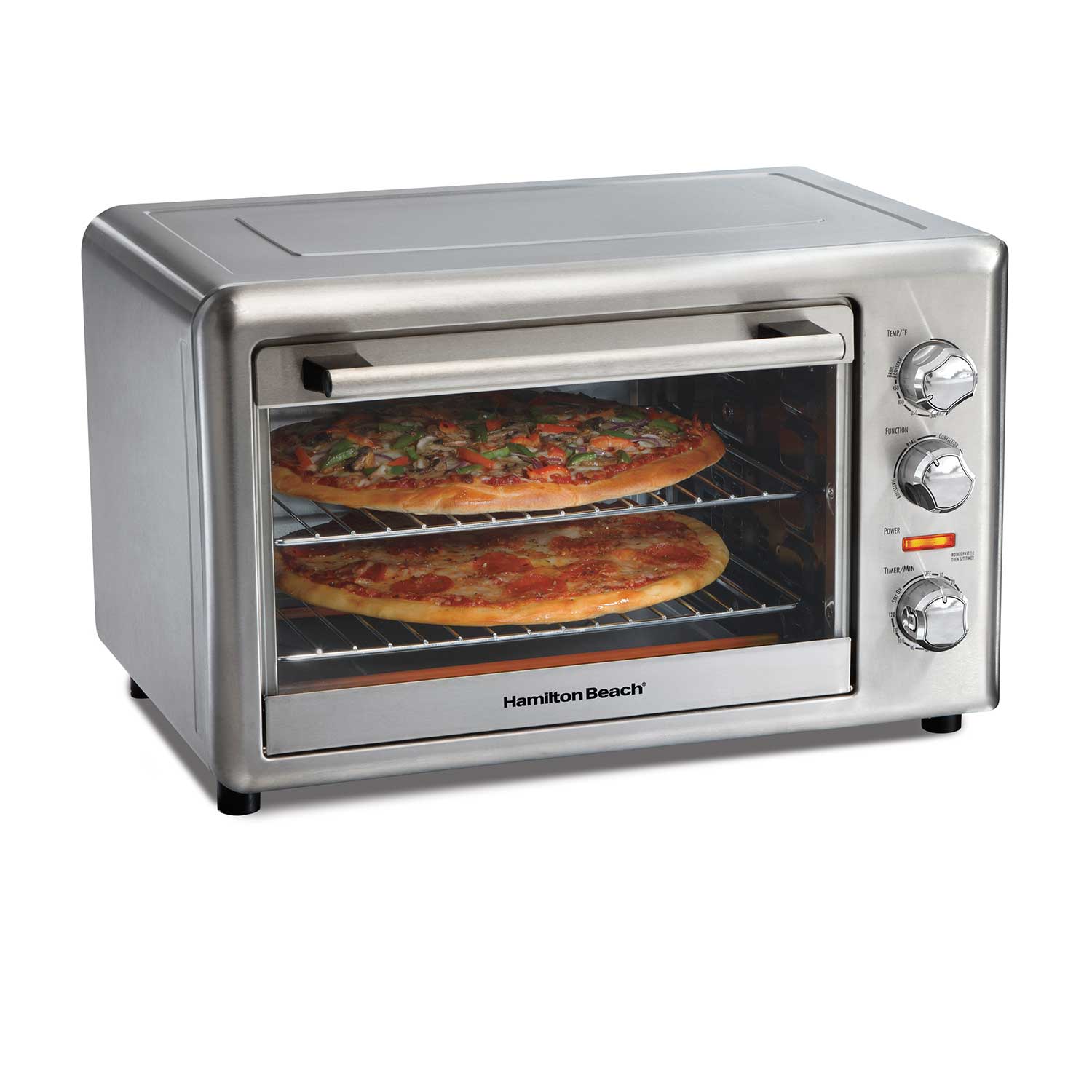
No. The guide describes separate setups: the two-pizza method uses two racks and a midway rack swap; rotisserie removes both racks and puts a coated pan in the lowest position.
Explore this need in the finder →Can I require a published cubic-foot capacity based on its casserole fit examples?
No. The maker gives dish-fit examples but no cubic-foot rating or interior dimensions, so those examples cannot meet a hard internal-volume minimum.
Explore this need in the finder →Does opting into earlier products make 31153D a buying-eligible model?
No. Earlier-model opt-in does not change the exact page’s NO LONGER AVAILABLE status or add an undocumented Toast function; this assessment remains a reference, not a purchase match.
Explore this need in the finder →The short answer: an owner reference, not a toaster-oven shortlist pick
The Hamilton Beach 31153D is easy to mistake for a conventional toaster oven because it appears in the maker’s toaster-oven archive. But its exact product page calls it a Countertop Oven with Convection and Rotisserie and lists Bake, Convection, Broil and Rotisserie—not Toast, Bagel or a number of toast slices. Hamilton Beach also marks the model “NO LONGER AVAILABLE.” If you need a toaster for daily bread, the published evidence is not enough to recommend this model, and a used listing would not change what the documented functions are.
There is still a useful audience for an exact reference: someone identifying a 31153D already at home, comparing a secondhand unit, or checking which manual family describes its controls. The maker’s 31153D page repeats that model number and the unavailable notice. It links the O51 Use & Care guide 840284902, which includes base model 31153 and explains the operating arrangements. That combination supports a careful owner’s assessment, not a current-buy recommendation.
Large fit examples, but not a published volume rating
Hamilton Beach describes enough room for two 12-inch pizzas, two 9-by-13-inch casseroles or two cake pans. It separately says the rotisserie fits a chicken up to five pounds. Those are practical examples, not a cubic-foot capacity or interior measurements. They do not establish that every pan with those nominal dimensions will clear the walls, racks or heating elements; handles and rim shape matter. The page gives outside dimensions of 14.5 inches high, 23.5 inches wide and 18 inches deep, but does not state the ventilation clearance envelope. Check the intended counter location and the instructions before treating those dimensions as a fit guarantee.
The two-pizza method is more involved than placing a single tray in a small oven. The guide says to put racks in the bottom and third positions, then exchange their positions about halfway through cooking so the pizzas cook more evenly. That is one cavity and one temperature, not independently controlled upper and lower zones. If you mainly want to warm one slice, these large capacity claims tell you little about speed or everyday convenience.
Four manual functions—and one important distinction
The controls are rotary rather than digital. The maker lists Bake and Broil, a Convection setting and a Rotisserie mode, with an automatic-shutoff timer up to two hours. Convection is a useful separate bake choice, but it is not proof of a dedicated Air Fry preset. There is no cited temperature range here, and the front image’s dial markings should not be treated as a verified numerical specification.
Rotisserie is a different setup from rack cooking. The guide directs the user to remove both racks, slide the coated pan into the lowest position for drippings, secure the food on the rod and use the supplied lift to remove the hot spit. The guide notes that only the upper heating elements operate in Rotisserie mode. That difference matters if you were hoping to cook a rotisserie item alongside two pizzas: these are separate uses of the cavity and hardware, not a simultaneous plan. Broiling also deserves attention; the guide cautions against leaving the oven unattended in that mode and requires space between food and the heating element.
What to look for instead
Choose a current toaster oven whose product page explicitly lists Toast and a slice capacity if toast is an essential job. Do not translate the 31153D’s pizza fit, convection fan or rotisserie into a toast specification. For a household trying to identify a legacy oven, match the full 31153D label and the O51 guide; do not assume a related black 31104D or unsuffixed family member has identical exterior dimensions, replacement parts or condition. The manual’s family panel lists 31153 and its suffix guidance, but a secondhand appliance still needs an intact cord, door, racks, crumb tray and rotisserie pieces. The page’s accessories list names replacement components, but current availability and fit for a particular used package are not guaranteed.
For cleaning, the guide says to unplug the oven and let it cool first, avoid metal scouring pads, keep the crumb tray installed and hand-wash and dry removable parts. These are useful checks for an existing owner; they do not overcome the model’s unavailable status or missing documented Toast mode. If you are shopping for a toaster oven rather than identifying one, use the finder with toast as an essential requirement and compare models that state that function directly.
Key details at a glance
| Nominal pizza size | 12 in |
|---|---|
| Named cooking functions | 4 |
| On-oven functions listed by the manufacturer | Bake / Convection / Broil / Rotisserie |
| Dedicated Air Fry preset | No |
| Dedicated Dehydrate preset | No |
| Convection fan/control documented | Yes |
More specifications and setup details
| Slow Cook preset | No |
|---|---|
| App-connected oven control | No |
| Appliance body width | 23.5 in |
| Appliance body depth | 18 in |
| Appliance body height | 14.5 in |
| Electrical rating | 1500 W |
| Factory-recertified listing | No |
| Included wired food-temperature probe with preset doneness control | No |
| French-door opening | No |
| Dedicated dough Proof program | No |
Use the exact model’s instructions for operating limits, supplied equipment and version differences.
Paper, software and setup details
App-only cooking modes
None documented; the exact model image shows manual rotary controls.
Listed supply voltage
The directly linked family guide rating panel lists 120 V / 60 Hz / 1500 W for its O51 model family, including base 31153 and suffix-letter guidance. A physical 31153D label was not inspected.
Included cooking pieces
['2 cooking racks', '2 baking pans', 'broiler rack', 'rotisserie accessories (guide depicts rotisserie rod/forks and lifter)']
Practical care and placement
The linked O51 guide says unplug and allow cooling before cleaning, hand-wash/dry parts to prolong their life, keep the crumb tray in place, and avoid metal scouring pads.
Sources for this assessment

Choose around the jobs you will actually repeat.
Check pan size, placement clearance and the exact model suffix before deciding.