
Your needs, this model
Does it fit your priorities?
Do you need a rotisserie spit and a separately selectable convection-bake setting in one oven?
Yes. The exact page names a revolving rotisserie and convection; its linked guide gives separate Convection and Rotisserie procedures. The unit still has one cavity and only one active function at a time.
Explore this need in the finder →Is a manufacturer-listed 12-inch pizza fit and a rotisserie more important than a dedicated toast preset?
The 31108 page lists 12-inch pizzas and a 5-pound rotisserie example. The guide says that two pizzas use separate rack levels and should be switched partway through cooking. It does not document toast.
Explore this need in the finder →Would Air Fry be essential alongside a rotisserie?
If Air Fry is essential, this is the wrong configuration: the exact 31108 page and its guide do not list an Air Fry program. Its documented cooking modes are Bake, Convection, Broil and Rotisserie.
Explore this need in the finder →Will the 20.62-inch-wide body fit a strict counter limit, before operating clearance?
A 21-inch body-width ceiling admits the listed 20.62-inch body; a 20.5-inch cap does not. The 16.54-inch depth also excludes a 16.5-inch body cap. Add clearance for safe placement and access separately.
Explore this need in the finder →Can the 31108 meet a required minimum cubic-foot capacity?
Not on the available maker documentation. It has useful food-fit examples, but neither the exact page nor its linked guide publishes cubic-foot volume; an essential volume minimum must remain unsatisfied.
Explore this need in the finder →Can it be selected for a published toast-slice minimum?
No. The exact 31108 documentation lists no Toast function or slice count, so an essential six-slice toast requirement remains unknown and cannot qualify this model.
Explore this need in the finder →Do you need two independently controlled oven zones rather than two rack levels?
The 31108 is one cavity with movable racks and one selected cooking mode. Two rack positions do not establish separate temperatures or schedules.
Explore this need in the finder →The Hamilton Beach 31108 is a roomy, manually controlled countertop oven built around two less-common jobs: convection baking and a rotating spit. Its maker lists two 12-inch pizzas or two 9-by-13-inch casseroles as fit examples, plus a separate five-pound chicken-or-roast rotisserie example. Those are not the same as a measured cavity volume, and the manual adds a practical catch for two pizzas: swap the upper and lower rack positions about halfway through cooking. If your regular routine is toast and quick snacks, this large single-cavity oven asks for counter space and hands-on cleanup you may not need.
Choose it for the spit and convection dial
The control panel is deliberately simple: temperature, function and timer are adjusted with three physical dials. The exact page lists convection, bake and broil settings alongside a revolving rotisserie; the directly linked Use & Care guide explains four function choices: Bake, Convection, Broil and Rotisserie. Convection is therefore a separately selectable oven-style mode, not a marketing synonym for Air Fry. This model has no documented Air Fry preset, Toast function or Bagel setting. If Air Fry or dependable daily toast is essential, start with another configuration instead of assuming that a rotisserie oven includes every toaster-oven staple.
Rotisserie is a real operating setup, not just a roast recipe. The guide says to remove both oven racks, put the coated baking pan in the lowest position to collect drippings, truss the meat so it cannot strike the pan, center it on the rod, and secure it with the forks. Only the upper elements operate in Rotisserie mode. The supplied lift helps move the hot rod; use mitts and leave the manual’s required space between food and heating elements. That procedure makes the spit useful for someone who will use it, but it also means more parts to position, clean and keep together than a basic bake-and-broil oven.
Two-rack capacity needs a little attention
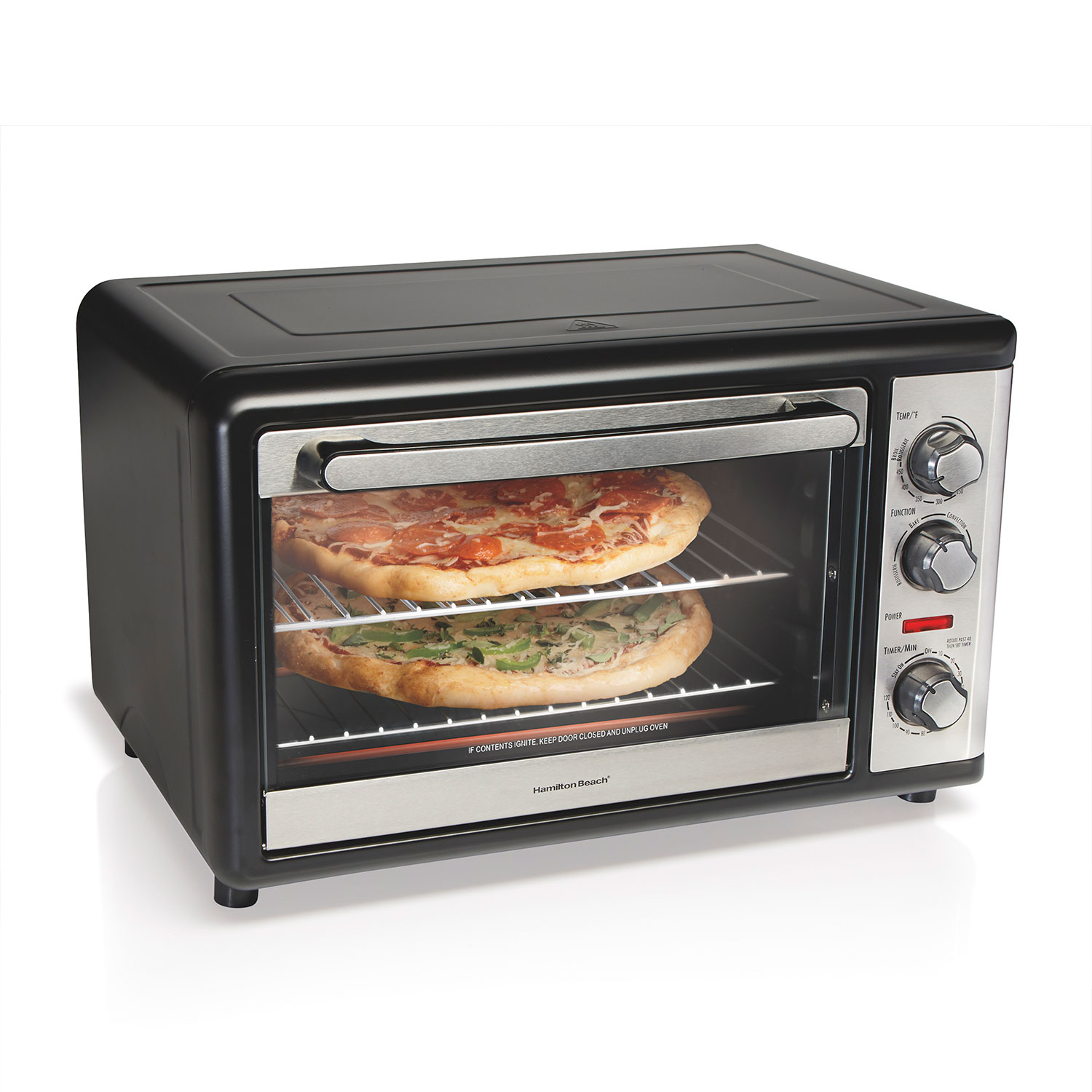
Hamilton Beach’s page says two 12-inch pizzas fit. The guide’s instructions explain how to make that two-level example work more evenly: cook for roughly half the recommended time, then exchange the rack positions so each pizza gets time closer to the upper and lower heat. Treat that as an operating step, not evidence that both pizzas cook identically without intervention. The page also names two 9-by-13-inch casseroles, but that fit example does not establish every pan handle, rim or recipe will clear the elements. Check the cookware you actually plan to use against the opening and the manual’s food-to-element spacing.
The listed body is 20.62 inches wide, 16.54 deep and 13.11 high. Measure your counter for the appliance itself, then leave additional room for the plug, door, hot pan handling and any placement clearances in the manual. The body dimensions are not a safe operating footprint. The maker does not publish cubic-foot capacity, interior measurements, toast-slice capacity or weight on the exact product page and linked guide. Do not turn the pizza and casserole examples into an invented volume estimate.
What comes with it—and what to verify
The product page lists an enamel-coated bake pan/drip tray, rotisserie skewer and lifter. The guide’s parts diagram also identifies two racks and a slide-out crumb/drip tray. For a new unit, confirm the delivered kit against its exact listing; for a used one, check that the rod, forks, lift, pan, racks and crumb tray are present and undamaged. The exact page links rotisserie replacement parts, but a parts link alone does not confirm fit across every suffix or individual appliance.
After cooking, unplug the oven and let it cool before cleaning. The guide recommends a damp soapy cloth for the interior and glass, separate cleaning of the crumb/drip tray, and hand-washing and drying removable pieces. It warns against abrasive cleaners and metal scouring pads and says not to cover the crumb tray with foil. These are straightforward instructions, but the larger cavity and rotisserie hardware make cleanup more involved than removing a small toaster-oven tray. The guide gives a one-year limited U.S. warranty for the original consumer purchaser, subject to its printed conditions; that is not a promise of remaining coverage on a secondhand appliance.
Which version, and when to look elsewhere?
The un-suffixed 31108 page did not carry a “no longer available” notice when checked, and Hamilton Beach’s U.S. pizza-oven listing showed the base model with an Add to Cart action. That is a dated maker-site observation, not a stock guarantee. The separate exact 31108G page does say “NO LONGER AVAILABLE.” Both pages publish the same title, settings, fit examples, listed dimensions and image, and both link the same O51 family guide. That guide names 31108 and allows alphabetic suffixes. The evidence supports covering the G as an earlier same-plan identity here; it does not establish that only the finish differs or that every replacement part is interchangeable. Verify the full label and parts for any used G model.
Shortlist the 31108 if you have room for its body and expect to use both the rotisserie and convection setting. Consider the 31193G instead when Air Fry matters alongside rotisserie; it is a separate, larger digital configuration, not an interchangeable 31108 variant. If you do not want a spit, compare smaller toaster ovens built around toast or an Air Fry basket rather than paying counter space to a feature you will leave in the cupboard. This assessment is based on Hamilton Beach’s exact U.S. pages and directly linked manual, not a cooking test or ownership report.
Manufacturer references: Hamilton Beach 31108 product page, O51 Use & Care guide, and separate 31108G product page. The manufacturer image shows staged pizzas; Hamilton Beach does not identify it as a photograph, rendering or composite, and it is not evidence of cooking performance.
Key details at a glance
| Nominal pizza size | 12 in |
|---|---|
| Named cooking functions | 4 |
| On-oven functions listed by the manufacturer | Bake / Convection Bake / Broil / Rotisserie |
| Dedicated Air Fry preset | No |
| Dedicated Dehydrate preset | No |
| Convection fan/control documented | Yes |
| Slow Cook preset | No |
| App-connected oven control | No |
| Appliance body width | 20.62 in |
| Appliance body depth | 16.54 in |
| Appliance body height | 13.11 in |
| Electrical rating | 1500 W |
| Factory-recertified listing | No |
| Included wired food-temperature probe with preset doneness control | No |
| French-door opening | No |
| Dedicated dough Proof program | No |
Use the exact model’s instructions for operating limits, supplied equipment and version differences.
Paper, software and setup details
App-only cooking modes
None documented in the exact page or directly linked guide.
Listed supply voltage
The directly linked O51 rating panel identifies model 31108 at 120 V / 60 Hz / 1500 W and expressly allows alphabetic suffixes after the model numbers; the 31108G page links this same guide. Check the complete rating label on an individual appliance.
Manufacturer warranty summary
The directly linked guide states a one-year limited warranty for the original consumer purchaser of a U.S.-purchased product, subject to its printed terms and proof-of-purchase requirement. This does not establish remaining coverage for a used unit.
Included cooking pieces
The exact product page lists an enamel-coated bake pan/drip tray, rotisserie skewer and lifter. The linked guide diagrams two oven racks, a slide-out crumb/drip tray, large coated baking pan, rotisserie rod/forks and lift. Verify parts and condition on any individual used unit.
Practical care and placement
Unplug and allow the oven to cool before cleaning. The guide says to wipe the interior and glass door with a damp soapy cloth, wipe the crumb/drip tray separately, hand-wash and dry parts to prolong their life, and avoid abrasive cleaners and metal scouring pads. It warns not to cover the crumb tray with foil; dishwasher compatibility is not claimed.
Sources for this assessment
- Hamilton Beach U.S. Toaster Ovens Product Archive snapshot identifying 31108 and 31108G
- Hamilton Beach Revolving Rotisserie Countertop Oven with Convection, exact model 31108
- Hamilton Beach Pizza Ovens listing with model 31108 and Add to Cart action
- Hamilton Beach Revolving Rotisserie Countertop Oven with Convection, exact model 31108G
- Hamilton Beach Use & Care Guide 840292702, directly linked from the exact 31108 and 31108G pages
- Hamilton Beach exact 31108 product-page hero image, also served by the separate 31108G page

Choose around the jobs you will actually repeat.
Check pan size, placement clearance and the exact model suffix before deciding.